
facing the place where the sun rises
the magical use of the four (five, six, or eight) directions
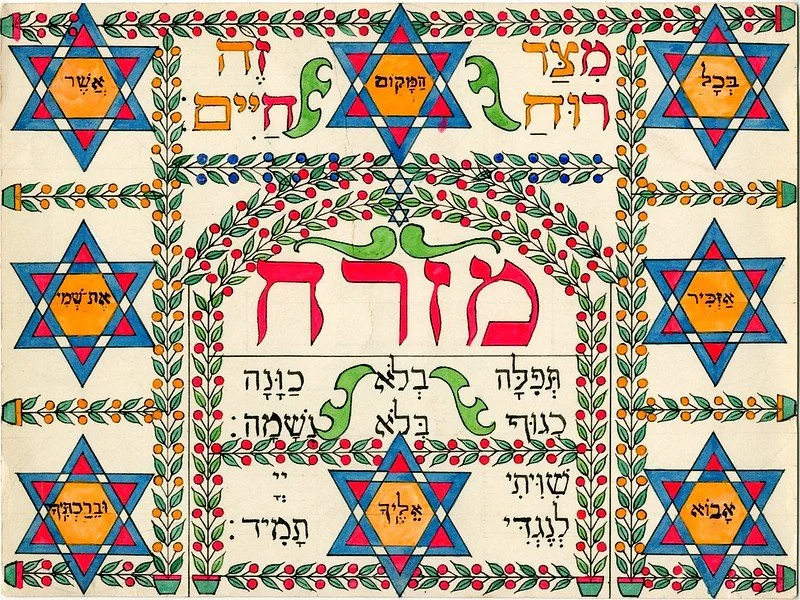
A Mizrakh • מזרח plaque, an art piece used to mark the Eastern direction (the direction of prayer in most of the world) in Jewish homes. In red in the middle is the word Mizrakh (“East”). Below it reads “prayer (tfilah) without intention (kavanah) is like a body without a soul” and “I place God before me always [Tehillim 16:8].” The seven stars surrounding it each contain one word at a time from Shemot 20:21, “in every place where I cause My name to be mentioned I will come to you and bless you.” Rabbi Reuben Moses Eschwege, 1967
The directions (four, five, six, eight, however many there are) are one of the more culturally universal esoteric concepts for interfacing with the spirit world. They are self-evident in our environment in so many ways and represent the interactive relationships between the Sun (and the rest of the sky) and our Earth.
I think the directions are a bit undersung as a whole in popular esotericism. When I began learning about magic they were presented to me as just one other thing in the litany of correspondences that we draw together to produce ritual magic. Some approaches to magic barely use them and, in others, they’re treated as a component of ritual but not much time is spent on them. Sometimes it feels like interacting with the directions is something that we do while checking the boxes.
I believe my first exposure to the magical use of the directions was in their neopagan application as a teenager.
I remember language of calling in the quarters or watchtowers given as something that you just simply must do before beginning your ritual. I have a relatively early magical memory of attending a public neopagan ritual as a teenager where the high priestess lifted up various implements and recited a formulaic invocation to each direction and that was that.
The legacy of this popular practice goes back to Gerald Gardner’s incorporation of Golden Dawn magical techniques, including the observation of the four Western elements, the directions and their directional guardians. It’s my understanding that they entered the Golden Dawn through their research of sources such as the Agrippa’s Three Books of Occult Philosophy and (MacGregor Mathers’ interpretation of) the Key of Solomon but especially from the spirit-led research of John Dee who conveyed us our first set of elemental and angelic directional attributions. It appears that our ancestors would have agreed that there are four directions which each govern a part of reality and have a guardian appointed over them but there was no strong consensus as to their essential nature (or the names of their individual guardians).
As I began to develop greater interest in historical magic, especially folk(loric) magic, the directions seemed to take a backseat. They would come up from time to time in subtle ways, for example in this spell for making a dowsing rod from The Long-Lost Friend, an early 1800s manual of braucherei:
On the first night of Christmas, between 11 and 12 o’clock, break off from any tree a young twig of one year’s growth, in the three highest names (Father. Son. and Holy Ghost), at the same time facing toward sunrise. Whenever you apply this wand in searching for anything apply it three times. The twig must be forked, and each end of the fork must be held in one hand, so that the third and thickest part of it stands up, but do not hold it too tight. Strike the ground with the thickest end, and that which you desire will appear immediately, if there is any in the ground where you strike. The words to be spoken when the wand is thus applied are as follows:
Archangel Gabriel, I conjure thee in the name of God, the Almighty, to tell me, is there any water here or not? do tell me! + + +
If you are searching for Iron or Ore, you have to say the same, only mention the name of what you are searching for.
I think this is a good example of what I mean because, although there is a stated directional component, it isn’t stated explicitly. The author doesn’t even give the name of a specific direction—I can imagine a novice contemporary practitioner who wants to follow this ritual googling “which direction is sunrise?”
This spell is interesting to me because its author tells us to go out for our ritual late at night on Christmas day but to do the ritual facing the direction the sun rises from even though it’s happening in the middle of the night. Whether the Sun is present or not, the direction it rises from is marked by its role as the gateway through which the Sun’s light reenters our lives each morning.
We’re also taking the presence of four essential directions for granted here.
Aside from the magical applications of the four directions, my earliest interactions with the mystical compass come through my observation of the Jewish holiday of Sukkot.
Observant Jews build an outdoor structure (a sukkah • סוכה) out of natural materials for our autumn festival, Sukkot. As part of the ritual observation of this holiday, we collect the leaves and/or fruit of four plants (The Four Species • ארבעת המינים) into a bundle and shake them in each of the directions with their requisite blessing.
I didn’t grow up building a sukkah each year but I was introduced to the practice when I began exploring my Jewish heritage with more observant friends as a teenager. I was immediately hooked. Sukkot is an earthy, plant-filled festival that’s both mystically complex and even a little spooky. It’s like if Día de los Muertos was also a camping party.
When we shake the four species we don’t only acknowledge the four directions (East, South, West and North) but also the Nadir and the Zenith (the directions of Up and Down). The directions exist in three dimensions after all!
At other times in Jewish culture, we see the directions reduced down to four—but not the four cardinal directions we’ve come to expect. Sometimes they’re in front, behind, to the right and to the left. Sometimes they’re just in front, behind, up and down.
In Chinese esotericism there are often five or eight directions mentioned—the four cardinal directions plus center (these five directions are then assigned to one of the five visible planets) or the four cardinal directions plus the four intercardinal directions (which are mapped to the bāguà • 八卦).
The directions are everywhere in our (and everyone else’s) ancestors’ mysticism, just not always the way we might expect to see them.
As someone who hasn’t been drawn as deeply into the study of Golden Dawn approaches to ritual magic, I don’t really have much practice with the way they do things.1 For a long time my practice has looked like reading old stuff that interests me, experimenting with recreating things I can/want/should, and using divination and spirit relationships to direct my practices as much as possible.
I would interact with the directions from time to time but I rarely felt like I understood why I was doing it and it often looked like the example from The Long-Lost Friend above.
Things changed for me in 2023.
I put in an effort to experiment with the directions as part of a yearlong project to recite the Gāyatrī Mantra every Sunday morning paired with ritually facing each direction when the sun rose. This was part of a series of solar remedies intended to support my natal Sun (a practice that I plan to revive again during my Leo profection this year). I sought to approach my directional rituals from a place of openness and experimentation rather than unquestioned Renaissance dogma.
Through this, I learned that ritual veneration of the four directions placed my spirit in the middle of the conversation between our Earth and the Sun and celestial spheres.
The directions themselves are the material representation of the movement of the Earth through space.
As we rotate on our axis together, the Sun appears to rise and set every day. This marks the axis of East and West. As we move through our orbit around the sun throughout the year the poles are inclined towards and away from the Sun. This marks the axis of North and South.
The four directions are the way that we experience with our bodies the rhythmic steady motion of our Earth around the star that birthed her.
Our biology as human animals is deeply ingrained in the patterns of light and darkness that we organize ourselves around every day and the cycles of seasons that we measure our lifespans against.
By venerating the four directions, we place ourselves, as practitioners, at the crossroads of that which produces our material reality.
It’s more than a box to check off on your list of correspondences or table to look up in a book, it is the root of life every familiar form of life on this planet.
Expect much, much more from me on this subject in the coming year as I re-immerse myself in the fourfold pattern of the directions in the coming years. This first essay was more of my philosophical take on why we should care about the directions. The next things I have planned will be much more practical and concrete.
I’m looking forward to doing magic with y’all again.
Notes
[1] To be clear, there’s basically no engaging with magic as a Westerner at this point in history without being a part of the Golden Dawn’s influence. It is present in my work without a doubt. I just mean to say that I haven’t deeply studied it myself—so wherever it shows up in my work it is unintentional through its presence in the magical overculture.
I often find myself surprised to learn what things I take for granted originated with Golden Dawn-style magic when taught that by my friends who have more deeply studied in that specific lineage.
If you think you haven’t been influenced by the Golden Dawn, that’s probably true for you too ;)